
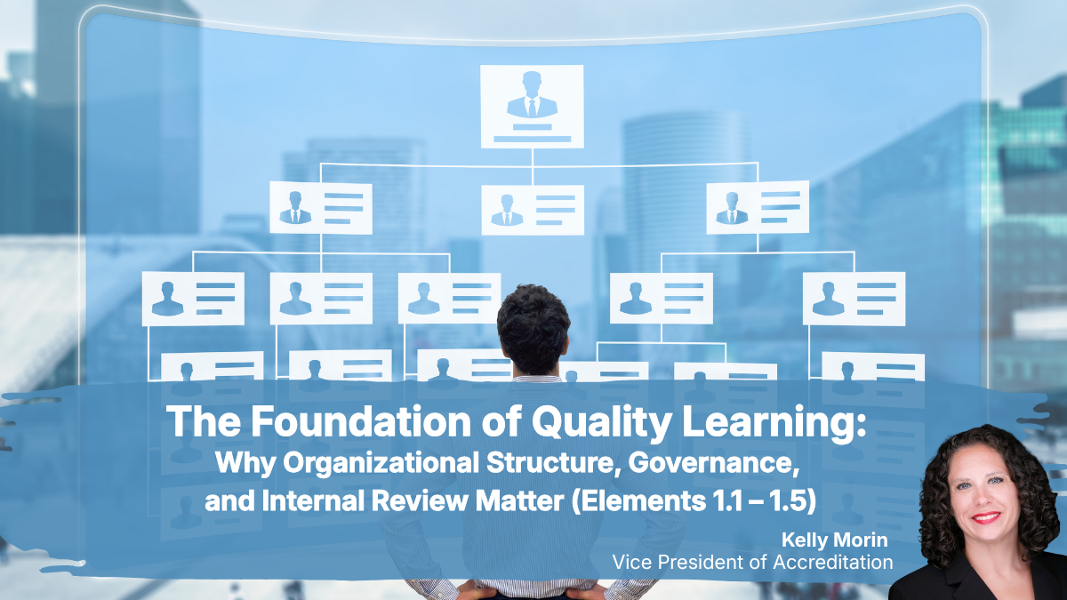
The Foundation of Quality Learning: Why Organizational Structure, Governance, and Internal Review Matter (Elements 1.1 – 1.5)
What is Quality?
High-quality training systems do not happen by accident. They are the product of intentional organizational design, clear governance, and disciplined internal review processes that reinforce consistency, accountability, and continuous improvement.
To meet the increasing expectations of learners, employers, and regulatory and certifying bodies, consistently excellent learning events that deliver results must be provided. This can’t happen if one course or outcome is built at a time. An integrated system that is deliberately built, maintained, and improved over time needs to be developed. That begins with an operational framework that provides sustainable support for program excellence.
The requirements in category 1 of the ANSI/IACET 1-2018 Standard for Continuing Education and Training (CE/T Standard) focus on ensuring the foundation—organizational structure, mission alignment, effectiveness measurements, and internal review processes—provides consistent quality across your entire organization.
“Build it and they will come”
The sustainability of a training program begins with legal standing (required by Element 1.1). When an organization is advancing through the process to be incorporated, registered, or otherwise recognized, thoughtful designs for long-term success must be shown. Intentional decisions about ownership, roles and responsibilities, finances, and operations have been made; potential learners interpret this as legitimacy to offer your training and education programs. Students begin to form their opinions before even registering for a class. In their eyes, the organization’s legal status shows a real, reputable training provider they can trust.
In addition to establishing legal legitimacy, training needs to be prioritized within the organization. Best-in-class training can’t be offered if it is an afterthought—"Joe’s Dog Grooming, Ice Cream, and Training, LLC.” When continuing education and training are an integral part of meeting the mission, conscious decisions are made about why training is provided and which outcomes need to be produced. Element 1.2 of IACET’s CE/T Standard underscores the importance of linking training to organizational success. If learning and development are crucial elements of the organization, sufficient people, funding, and tools will be provided to ensure excellent learning opportunities can be offered now and in the future.
Regardless of the size of the training department, with adequate resources, an organizational structure can be developed that allows for alignment of responsibilities to specific roles based on knowledge and skillsets.
By thoughtfully identifying the required work and assigning it to the appropriate people, the risk caused by unclear roles, overlapping responsibilities, and gaps in work processes is mitigated. When defining the functional structure for training and its place in the larger organization, don’t overlook the importance of assigning responsibility for training quality (Element 1.3 of the CE/T standard). If not explicitly defined, quality management becomes one of the gaps in work that poses a risk to learning programs. Assign someone to maintain, review, update, and monitor standard operating procedures as part of the continuous improvement plan.
“What gets measured gets done”
You’ve probably heard the adage, “what gets measured gets done”. If learning and development outcomes are to meet organizational objectives—a key requirement of quality—a robust continuous improvement process to evaluate both program outcomes and function is needed.
By aligning metrics for the training function with the mission and designing the organization to achieve success, a foundation is laid for your continuous improvement program. Without organizational measurement, the program is left with course-by-course evaluation, which can indicate that learners like the courses, but doesn’t ensure a lasting impact. To demonstrate contributions to organizational strategy, a line needs to be drawn from the learning program to improving student skillsets, and ultimately to the impact of a highly skilled workforce on company performance. When comparing performance to intentionally defined metrics, data-driven decisions can be made to improve effectiveness and ensure value. Element 1.4 of IACET’s CE/T Standard directs high-quality learning organizations to thoughtfully design their process for evaluating organizational effectiveness, including who will conduct it, what they will do, when and how often they will do it, how they will report their findings, and how the results will drive decision-making.
Continuous improvement programs should include more than organizational success metrics. Sustainability and quality in training require consistently implementing processes and procedures. To encourage staff to follow established policies and procedures, they must be tracked. Processes should be regularly evaluated to determine whether they provide the desired results for the organization. If they do, they need to be enforced. If staff don’t follow them or the procedures don’t provide the expected results, find out why and revise them to better meet organizational needs. Without regular review of your compliance with policies and procedures, it is easy to drift into sporadic operations (Element 1.5 of the CE/T Standard). To ensure long-term stability and consistency, explicitly assign responsibility for compliance. Clearly articulate who will conduct the reviews, how reviews will be conducted, when and how often reviews happen, what will be reported, and which decisions will be driven by the data.
Defining organizational structure, roles and responsibilities, continuous improvement programs, and compliance monitoring aren’t administrative burdens. Together, they form a comprehensive quality system that supports learners, strengthens organizational credibility, and ensures training programs remain relevant, effective, and aligned with critical needs.
To see how defining their structure, policies, processes, and quality review cycle led one organization to scale their operations without compromising quality, check out our Case Study on AVO Training Institute.
To learn more about how to incorporate the elements of quality systems in your training organization and achieve accreditation, check out our complimentary Guide to IACET Accreditation or attend a free Introduction to IACET Accreditation Webinar.
About the Author

Obsessed with integrating quality throughout the training ecosystem, Kelly has dedicated her career to ensuring learners have access to training that helps them succeed in their careers, and organizations have the right people with the right skills in the right roles to accomplish their strategic goals.
Kelly is an experienced talent development leader with more than 20 years of training and development experience in the military, federal government, corporate, and higher education sectors. As IACET’s Vice President of Accreditation, she leverages her diverse background to help you find the right path to achieve your accreditation and quality goals, regardless of sector.
Before joining the IACET team, Kelly supported IACET’s vision of a world that learns better by participating on and chairing the Open Digital Credential taskforce, participating on the Competency Based Training taskforce, and serving on IACET’s Board of Directors.