
Strategy and Alignment: The North Star of Great Training
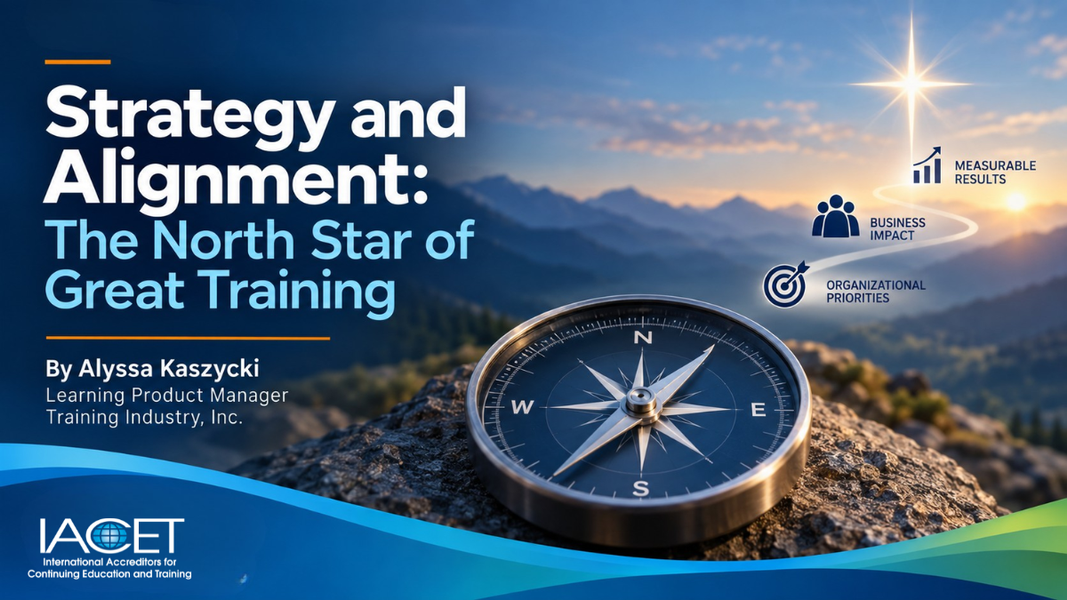
What makes training effective? When you first think about this question, you probably jump to great facilitators, engaging content or well-designed materials. While these factors matter, truly effective training is defined by its alignment to organizational strategy and measurable results.
What Are We Doing, Really?
Too often, training programs fail not because of a lack of effort from the training team or poor content design, but because they are disconnected from a clear organizational purpose. Every training program should be able to answer the question: “What are we trying to accomplish?”
Leadership training, for example, may sound great on paper, but truly effective leadership training connects to organizational priorities, supports measurable outcomes and drives business impact. Without strategic alignment, even high-quality training will struggle to deliver meaningful results.
What Does Strategic Alignment Look Like? Considering Training Industry Research and ANSI/IACET Standards
Training Industry has conducted over a decade of research into what makes a great training organization. That research has identified strategic alignment as the most important process capability for great training. More than 1,500 training professionals rated the following best practices as the most important elements of strategic alignment:
- Customize training to meet organizational needs: There’s nothing wrong with using off-the-shelf content, but training becomes far more effective when it’s contextualized with organization-specific examples, activities or case studies tied to real business priorities.
- Establish agreed-upon business objectives: It’s critical to understand what stakeholders hope training will accomplish and what organizational outcomes they expect it to influence.
- Adapt training to the organization’s culture and environment: The skills employees need, and the most effective ways to develop them, can vary significantly across industries, functions and workplace cultures. Thus, training should reflect the realities of learners’ day-to-day environments.
- Develop consultative partnerships with stakeholders: It’s critical that senior leaders and stakeholders view L&D as a strategic partner, not simply a team that fulfills training requests. Strong stakeholder relationships create opportunities for deeper impact.
- Define performance success metrics: Once goals are established, align with stakeholders on how success will be measured using observable performance indicators or business metrics.
Together, these best practices highlight the importance of stakeholder relationships, organizational understanding and measurable outcomes in building effective training programs. These same principles are reflected in professional development programs designed to build strategic capability within L&D teams. For example, Training Industry’s Certified Professional in Training Management (CPTM™) program emphasizes strategic alignment, stakeholder partnerships and business-focused training strategy as core competencies for modern learning leaders. If you’re curious about your own strategic alignment capabilities, you can assess yourself with Training Industry’s Training Manager Competency Model Self-Assessment.
With this in mind, it makes sense that one of the very first standards outlined in the ANSI/IACET Standard for Continuing Education and Training states that, “The Provider shall support the development, administration and delivery of the training it provides with a mission statement, statement of goals and/or other strategic documentation.” This highlights the critical nature of managing training within the framework of an established mission and strategy.
What If I Don’t Know My Organization’s Strategy?
Believe it or not, this challenge is more common than you might think. Unfortunately, training departments are often left out of crucial conversations around organizational strategy and are positioned as service providers rather than strategic partners.
If that’s the case for you, start where you can. Build relationships with senior leaders, even informally at first. The more visibility you have into leadership priorities, the easier it becomes to align learning initiatives with broader organizational goals. If direct access to leadership isn’t possible, review company materials like mission statements, annual plans, quarterly updates or internal communications to better understand your organization's direction.
The Risk of Remaining an Order-Taker
You can simply fulfill training requests, but stakeholders don’t always understand when training is — or isn’t — the right solution to a performance problem. As a result, L&D teams may be asked to solve issues that training alone can’t fix and then be blamed when outcomes fail to improve.
Over time, this creates poor perceptions of training’s value and weakens the strategic position of the training function. In organizations facing budget pressure, it also increases the likelihood that leaders begin asking, “Why are we investing in training at all?”
A Final Thought
Strategic alignment is the foundation of effective training. Without it, even the most engaging content, skilled facilitators and innovative delivery methods will fail to create meaningful organizational value.
For instance, I could build a best-in-class course on dog grooming with expert facilitators, engaging activities and cutting-edge technology, but unless my organization has a business need tied to dog grooming, that training will accomplish very little. While it may sound like a silly example, misaligned training enters organizational learning portfolios every day. Make sure yours isn’t one of them.
About the Author

Alyssa Kaszycki is a learning product manager at Training Industry, Inc., where she develops courses that help training and development professionals build more effective learning organizations. Her expertise includes learning strategy, course development and evaluation. She also contributes to industry research and thought leadership on emerging topics including artificial intelligence and careers in learning and development.