
Technology Should Support Learning
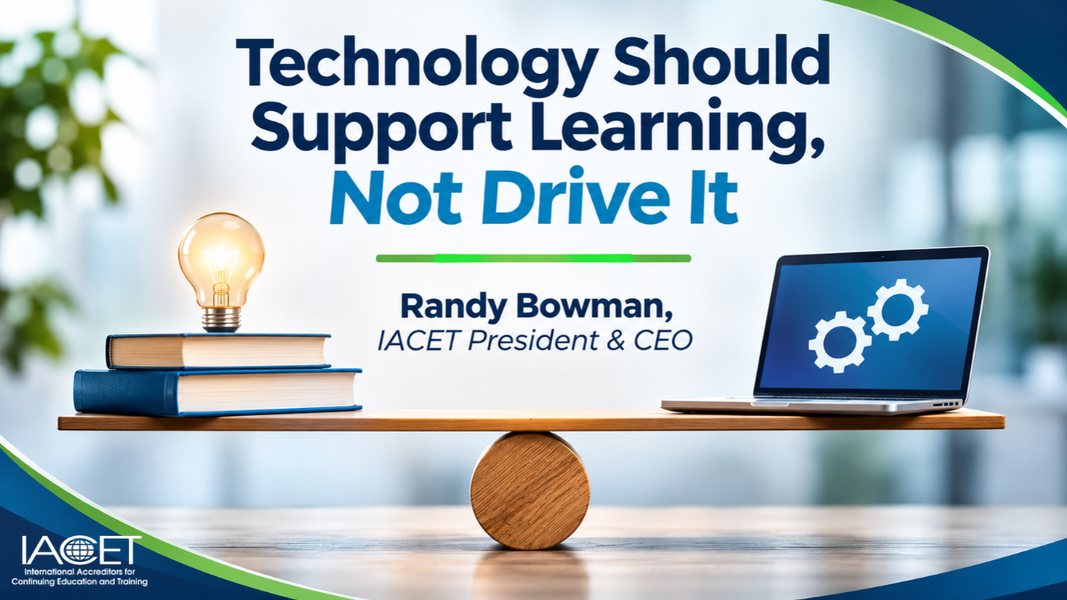
The other day, my wife (who teaches middle school) lamented that her students don’t really write anymore. She was considering requiring some assignments to be completed with pen and paper.
Naturally, I offered my full support.
“Why stop there?” I asked. “Perhaps you should give them handheld chalkboards. Or papyrus and a quill. Better yet, clay tablets they can etch their answers into.”
I was teasing, of course, but beneath the joke is an interesting question: What exactly counts as technology?
We tend to use the word as shorthand for whatever is newest and digital. Yet a pencil is technology. So are a flip chart and marker, a printed workbook, a classroom, a projector, a learning management system (LMS), and a sophisticated learning experience platform. Each is a tool developed to help people accomplish something.
That is why the real question is not whether a learning organization uses technology. Every learning environment does. The better question is whether its technology supports the learning or… has it begun to drive it?
Platforms Are Only One Part of the System
I often think about a learning quality management system as being the intentional integration of the six P’s: policies, processes, people, platforms, performance, and protection.
Platforms include all the tools, as well as all the physical, digital, and experiential environments in which learning is designed, delivered, assessed, evaluated, and documented. They may include classrooms, equipment, job-site simulations, templates, checklists, authoring tools, registration systems, an LMS, or an entire interconnected technology ecosystem.
Platforms matter, but they are only one of the six P’s. To be effective, they must work in concert with the other five.
The organization’s policies establish its commitments and expectations. Its processes turn those commitments into consistent action. Its people exercise judgment, deliver instruction, and support learners. Performance data shows whether the system is producing its intended results. Protection mechanisms ensure that quality persists when the organization experiences disruption.
A platform should help connect and strengthen those elements…but it should never replace them.
Software May Enforce the Process, but It Should Not Dictate It
One of my axioms about organizational technology is that software should adhere to established policies and processes, but it should not dictate what those policies and processes must be.
Suppose program evaluation reveals that a learning process needs to change. Perhaps learners need a different communication sequence, instructors need an additional review step, or an assessment method is not producing useful evidence. The organization has both the responsibility and the authority to improve that process.
But what happens when the software will not allow the change?
If the response is, “That’s not how the system works,” the organization faces more than a technical inconvenience. It faces a governance problem. If you cannot improve a policy or process because your platform prohibits it, you no longer have full authority, responsibility, and control over your learning system. Your software vendor does.
Technology should create capacity, not captivity.
Quality Standards Need Technical Standards
This is also why interoperability should matter when organizations select learning technology. A platform may work beautifully today, but programs change. Organizations grow. New partners, reporting requirements, credentialing systems, and learner needs emerge.
Open technical standards allow different systems to exchange and interpret information consistently. Choosing products certified to recognized interoperability standards reduces dependence on proprietary connections and makes it easier to move data, integrate new tools, and adapt the learning environment without rebuilding it from scratch.
Organizations committed to quality management standards should also pay attention to technical standards.
This belief is part of IACET’s relationship with 1EdTech Consortium. IACET has published the ANSI/IACET Standard in 1EdTech’s CASE® format, making it digitally referenceable and interoperable across learning and workforce systems. The substance and authority of our Standard remain ours; CASE provides a common technical structure through which other systems can reference and use it.
This is exactly the relationship technology should have with an organization. The technology strengthens access, connection, and usability without taking ownership of the underlying purpose.
Choose the Tool That Serves the Learning
Sometimes the right learning environment will require a complex LXP supported by multiple integrated systems. Sometimes it will require a complex virtual or augmented reality platform. Other times, nothing more complex than a flip chart and a marker or, as my wife wondered, the best tool for the outcome may be a sheet of paper and a nub of pencil.
The newest technology isn’t always the best technology. The simplest is not automatically the most authentic. The right platform supports your policies, enables your processes, equips your people, measures performance, protects continuity, and remains adaptable when the system needs to improve.
Technology should support learning. It should never become the reason learning must be done a certain way.
About the Author

Randy is a seasoned executive leader currently serving as the President and CEO of IACET, a non-profit accrediting body in the continuing education and training sector. With a focus on strategic vision and operational excellence, he effectively leads the organization to achieve its mission and goals.
With over two decades of experience in various leadership roles, Randy has a proven track record of driving organizational success. His expertise lies in aligning technological solutions with strategic objectives, ensuring operational efficiency and sustainable growth.