
Andragogy Angst: Why Your Tools Shape Learning More Than Your Content Does
You notice a streaming platform most when it fails. Come on, you know what I’m talking about: that buffering wheel during the climactic scene, the search function that can't find a show you watched last week, or subtitles that are either two seconds behind or formatted so badly they cover the image. When the platform works, it's invisible, and you’re immersed in the content. But when it doesn't, the platform becomes the experience, and the content takes a backseat to your frustration at the infrastructure delivering it.
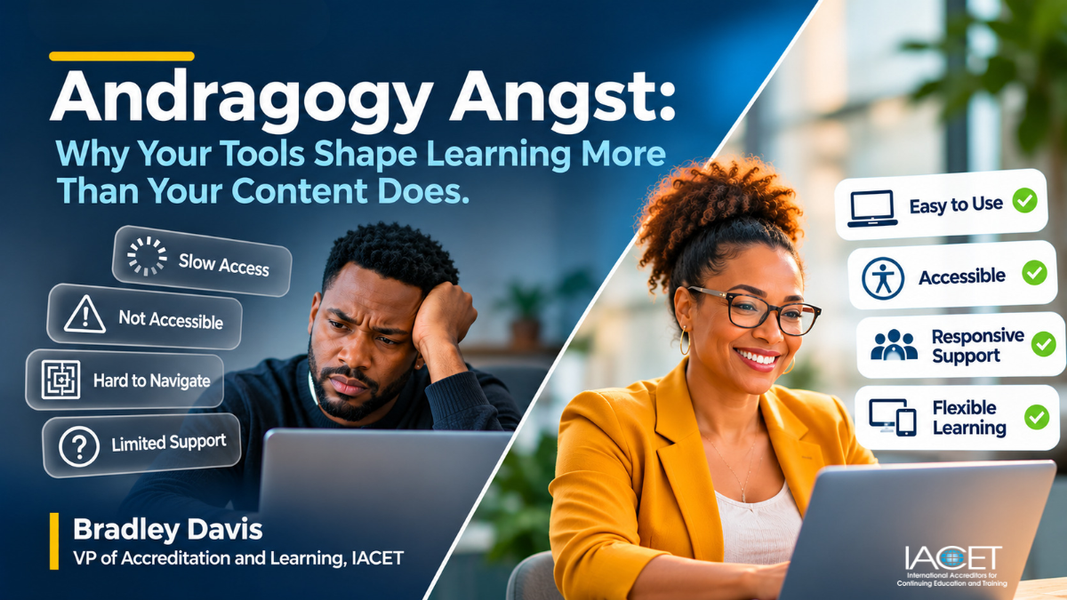
I say all of that because it’s pretty dang similar to when the learning management system fights the learner at every turn during a learning experience—where the registration process requires six clicks too many, or the materials are hosted on a platform that isn’t mobile accessible. In those cases, it doesn’t matter if the content is amazing or the instructional design would end all problems across the world. What matters is that the platform has already shaped the learner's experience before the first learning objective ever appears on screen.
The Environment You Build Is the Experience You Deliver
ANSI/IACET Standard Category 2, Learning Environment and Support Systems, exists because the accreditation community recognized something that the streaming industry figured out years ago: your infrastructure is not neutral. The tools you choose, the platforms you build on, the resources you provide, and the support systems you wrap around the learning experience aren't just logistical discussions; they’re andragogical necessities. They shape what learners can access, how they engage, whether they persist, and ultimately, whether they achieve the outcomes your program was designed to produce.
This is the part of quality assurance that doesn't get enough attention, partly because it's less glamorous than instructional design or assessment strategy, and partly because the people making technology stack decisions are often different from the people designing the learning. The platform team and the curriculum team operate in parallel, and the assumption is that if the content is strong, the delivery mechanism is interchangeable. But anyone who's tried to facilitate a meaningful discussion in a platform built for asynchronous content knows that's not true. The tool shapes the experience, whether you planned for it to or not.
When the Platform Tells a Different Story
Let’s get back to the important stuff here: what’s on my television. Netflix's documentary Reality Check: Inside America's Next Top Model is a fascinating case study in making this an environmental tension to manage. On one hand, the documentary reveals how America’s Next Top Model’s environment was, by any honest measure, a toxic learning space. The challenges were constructed for dramatic television, the support systems contestants needed were absent, and the production tools prioritized spectacle over growth. While the format said development, the infrastructure said entertainment. And even if they couldn’t name it at the time, the people inside the experience felt that gap viscerally, impacting their relationships with the content both inside and outside the studio.
But here's what makes the documentary more than a cautionary tale: Tyra Banks herself was a masterclass in understanding platforms. Whatever you think about the environment she built for contestants, her ability to read a medium, pivot between formats, and leverage every environment she entered to maximum strategic advantage is extraordinary. She understood, instinctively, that the platform shapes the experience, that tools and environment aren't neutral, and she applied that understanding relentlessly to build her own brand across television, media, and business empires. The problem was never that she didn't understand the power of the platform, but rather that the platform's power was oriented toward production value rather than toward the development of the people going through the experience.
For CE/T providers, that distinction matters enormously. Understanding your tools and environment is powerful, but we must always ask who that understanding actually serves. If your platform decisions are driven by what's easiest to administer, cheapest to license, or most impressive in a demo, you're building an environment that serves the organization. If they're driven by what helps learners access, engage, persist, and achieve, you're building an environment that serves the experience. Both approaches require reading the problem; they just point to it from different directions.
Building Infrastructure That Serves the Learning
The streaming platforms that get it right treat infrastructure as a product, not a container. They invest in recommendation engines because discoverability affects engagement, and those platform decisions ultimately become content decisions, because the platform determines how content is experienced.
CE/T providers can learn from this approach. Treat your LMS, registration system, pre-event communications, learner support resources, and accessibility features as part of the learning design. And if you're not sure whether your infrastructure is serving your learners or just housing them, try this: go through your own program as a learner. Register, navigate the platform, find the support resources! Heck, try to access the materials on your phone or send a request for accommodation. If at any point you find yourself fighting the system to get to the learning, you've found the gap your learners did a long time ago but stopped trying to tell you about.
The best learning experiences feel effortless because someone made thousands of infrastructure decisions with the viewer in mind. The worst ones remind you constantly that you're using a platform. The same is true for continuing education: the best learning environments feel like they were built for the learner, but the worst ones feel like the learner was an afterthought in a technology procurement process.
Tools, platforms, resources, and support systems aren't the backdrop to learning programs; they’re architecture on which you build your success. And like any architecture, they communicate values, whether you intend them to or not. Just maybe try to use your powers for good instead of spectacle.
About the Author

Bradley A. Davis, CAE, BRMP, is the Vice President of Learning Strategy for the International Accreditors for Continuing Education and Training. His leadership philosophy — emphasizing equitably meeting subject matter experts, contractors, staff, clients, members, volunteers, and prospective personas where they are, whenever they are — has ensured strong connections across his various work environments, promoting life-long value throughout constituents’ tenure. Bradley graduated from Southeastern Louisiana University with a B.A. in History, in addition to earning both a Master of Military History and a Certificate in Teaching and Learning from Norwich University. A 2024 Forty Under 40, 2024 – 2026 ASAE Diversity in Executive Leadership Scholar, and 2026 Emerging Training Leader of the Year, he has earned the Business Relationship Management Professional credential from the BRM Institute as well as the Certified Associate Executive credential from ASAE.