
Credit Conspiracy: How the 'Informal' Label Became CE/T's Most Expensive Misconception
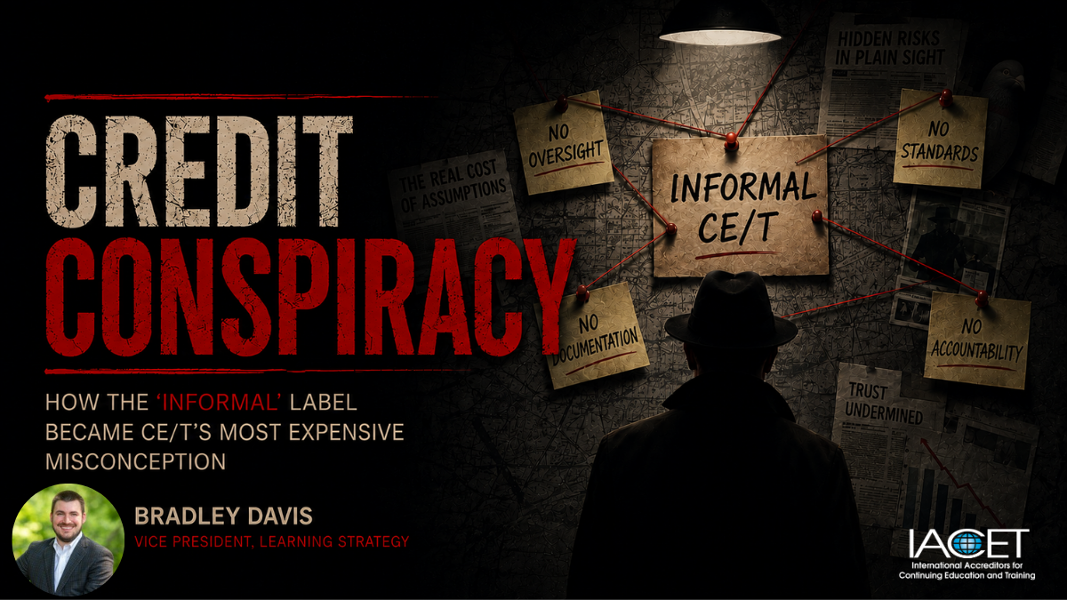
Confession time: I love a good conspiracy theory. No, not in the "I've-done-my-own-research-and" kind of way, but more a “Wow, how can you not admire this?!” perspective. Birds aren't real, the moon landing was staged, the earth is flat, and the world's airlines are in on it—they’re like a musical earworm for pop culture. These ideas are obviously absurd, but what makes them fascinating isn't the theory itself, but rather the popularity. It's the way they take root, spread through conversation, and eventually become so embedded in the culture that people repeat them without even thinking about where they came from.
Which brings me to my favorite conspiracy theory in our industry: the idea that continuing education and training is "informal."
I don't know who said it first, let alone when it caught on. But at some point, the entire professional development community accepted the premise that the education happening post-diploma—after the degree, after the ceremony, after the handshake and the student loan paperwork—is somehow less structured, rigorous, and worthy of the word "formal" than what came before it. And like any good conspiracy theory, the more people repeated it, the more real it became.
Breaking News: Evidence Doesn't Support the Theory
It doesn’t take too much digging to see where the conspiracy falls apart. Consider what the "informal" continuing education and training ecosystem actually looks like in practice: state licensing boards across healthcare, engineering, education, and public safety mandate specific credit hours, documented learning outcomes, and approved provider oversight for professionals to maintain their credentials. National Council of Examiners for Engineering and Surveying (NCEES), for example, requires licensed engineers to complete continuing professional competency activities through providers that meet defined quality standards. The National Association for the Education of Young Children (NAEYC) sets requirements for early childhood educators that include documented professional development tied to specific competency frameworks. K-12 teacher license renewal in nearly every state demands structured, assessed, and reported learning activities, and that doesn’t even include the hundreds of hours and requirements for healthcare education, regardless of the discipline of choice.
Does any of that sound informal to you?
The organizations operating in this space maintain documented instructional design processes, qualified instructors, structured assessment strategies, and outcomes-based evaluation systems. They report to regulators, respond to audits, and track learner achievement against defined standards. They do this across sectors, across borders, and at a scale that dwarfs traditional degree-granting education. An estimated 70 to 100 million adults participate in continuing education and lifelong learning activities each year in the United States alone. That's three to five times the enrollment of the entire traditional higher education system.
Again, does any of that sound informal to you?
What the Label Actually Costs Us
The problem with conspiracy theories is that they're not just wrong; they're expensive. The "informal" label has real consequences for the professionals and organizations working in this space every day.
When policymakers, funders, and institutional partners hear "informal," they hear “optional”. They hear “unstructured” and that it’s "nice to have." The label permits decision-makers to deprioritize professional development budgets, to question whether CE/T investments require the same accountability frameworks as other education spending, and to treat the entire sector as a lesser category of learning. That perception gap translates directly into funding gaps, policy gaps, and recognition gaps that practitioners then spend years trying to close.
Moreover, when the field accepts "informal" as its identity, it creates a vacuum where anyone can step in and define what quality means. Without a shared insistence on rigor, the market and the industry fragments. Providers with robust quality systems compete on a level playing field with providers who have none, and learners can't distinguish between a credential that required documented evidence of learning outcome achievement and one that required attendance and a pulse (which, let’s be honest, is sometimes optional). The "informal" label actively undermines the organizations doing the work right, which leads to the biggest crush of all: talent.
The professionals who build, manage, and deliver continuing education and training programs are doing sophisticated, high-stakes work. They're designing learning experiences that help nurses maintain patient safety competencies, engineers stay current on structural codes, and educators adapt to evolving classroom realities. Calling that work "informal" doesn't just misrepresent the sector; it disrespects the people in it, those who are supporting the single largest education sector across the world.
Professional Credit for the Modern Workforce
All of this—the label, the loss, the identity, and the talent—is why the ANSI/IACET Standard for Continuing Education and Training exists: to provide the structured, internationally recognized quality framework that the workforce deserves and that its learners, employers, and regulators increasingly demand. IACET-accredited providers don't operate in an informal ecosystem; they operate under a standard that requires documented needs analyses, qualified instructional personnel, defined learning outcomes, valid assessment strategies, and continuous improvement practices. There’s nothing informal about this space, let alone the people who thrive in it, and that’s why IACET and other standards-developing organizations matter.
Because together, we’re validating — let alone empowering — a professional credit for the modern workforce.
Debunking the Theory
The best conspiracy theories survive because they're easier to repeat than to investigate. "Informal education" rolls off the tongue; it sounds modest and self-aware, like we're the approachable corner of the education world that doesn't take itself too seriously. But modesty isn't a strategy, and a label that encourages your stakeholders, funders, and policymakers to underestimate the rigor of your work is less about humility than liability.
So, here's my pitch: let's retire the conspiracy. Let's stop calling this sector informal when everything about the way it operates tells a different story. Let's talk about professional credit, workforce-critical learning, and quality systems that hold up to regulatory scrutiny across fifty states, six continents, and dozens of industries. Let's describe this sector as it actually works, not as a decades-old shorthand suggests it does.
After all, the birds-aren't-real crowd eventually became a parody of itself. I'd rather not wait for the same thing to happen to us.
About the Author
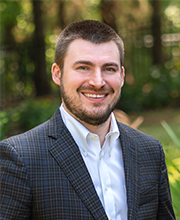
Bradley A. Davis, CAE, BRMP, is the Vice President of Learning Strategy for the International Accreditors for Continuing Education and Training. His leadership philosophy — emphasizing equitably meeting subject matter experts, contractors, staff, clients, members, volunteers, and prospective personas where they are, whenever they are — has ensured strong connections across his various work environments, promoting life-long value throughout constituents’ tenure. Bradley graduated from Southeastern Louisiana University with a B.A. in History, in addition to earning both a Master of Military History and a Certificate in Teaching and Learning from Norwich University. A 2024 Forty Under 40, 2024 – 2026 ASAE Diversity in Executive Leadership Scholar, and 2026 Emerging Training Leader of the Year, he has earned the Business Relationship Management Professional credential from the BRM Institute as well as the Certified Associate Executive credential from ASAE.