
Childcare vs. Daycare: Small Words, Big Implications
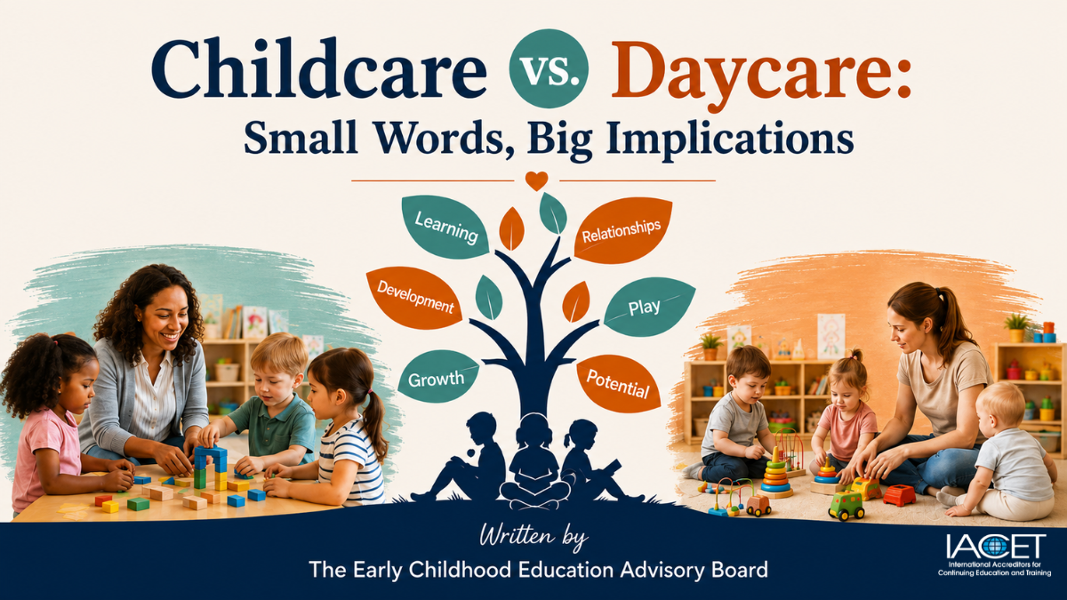
In the world of early learning, words matter. The language we use shapes public perception, professional identity, policy conversations, and even how families value the work happening inside schools and classrooms every day. One phrase that continues to surface in conversations across the industry is the difference between “daycare” and “childcare.”
At first glance, the distinction may seem minor. After all, both terms involve caring for young children while families work or attend school. But for early childhood professionals, the difference is much broader than semantics. It reflects how society understands—or misunderstands—the profession itself.
Early childhood professionals do not “watch the day.” They nurture children.
That is why many professionals prefer the term “childcare” over “daycare.”
The word “daycare” unintentionally places the emphasis on time. It suggests supervision during the day—a service-focused primarily on keeping children safe until parents return. While safety and supervision are certainly essential, they are only a fraction of what high-quality early childhood programs provide.
“Childcare,” on the other hand, places the focus where it belongs: on the child.
Within quality early childhood environments, educators do far more than manage schedules and routines. They build the foundation for lifelong learning, social-emotional development, communication, problem-solving, creativity, and resilience. They observe developmental milestones, create intentional learning experiences, foster relationships, support families, and help children learn how to navigate the world around them.
That is not just “daycare.”
It is education, development, and human connection during the most critical years of brain growth.
Research consistently shows that the early years of life have a profound impact on future academic achievement, emotional well-being, and long-term success. Early childhood professionals are among the first teachers a child will ever have. They help shape confidence, language development, emotional regulation, curiosity, and social skills before children ever enter kindergarten.
Despite the complexity and importance of the work, the field has historically struggled with professional recognition. Language plays a role in that challenge.
When society casually refers to programs as “daycare,” it can unintentionally minimize the expertise, intentionality, and professionalism required to work in early childhood education. It can reduce a highly skilled profession to simple babysitting or time-filling. For educators who spend years developing their craft, obtaining credentials, participating in ongoing professional development, and dedicating themselves to children and families, that distinction matters.
This is not about correcting families or creating division over terminology. Many parents use the term “daycare” simply because it has become common language over generations. Most do not intend disrespect. In fact, many families deeply value and appreciate the teachers caring for their children each day.
The conversation is not about judgment; it is about elevation.
As a profession, early childhood education continues to evolve. Programs are increasingly focused on curriculum, developmental best practices, social-emotional learning, inclusion, family engagement, continuous improvement, and school readiness. Teachers and leaders are participating in accreditation systems, professional learning communities, coaching cycles, and data-informed practices that mirror the work happening across K–12 education.
The language we use should evolve alongside that growth.
Words shape identity. When professionals consistently refer to themselves as early childhood educators, childcare professionals, or learning leaders, it reinforces the understanding that this work is both relational and educational. It helps families, policymakers, and communities recognize that early learning environments are not simply places children “stay” during the day—they are places where children grow.
At the heart of it all is one simple truth:
Early childhood professionals take care of children, not the day.
They comfort infants during their first transitions away from home. They celebrate first steps, first friendships, and first moments of independence. They teach problem-solving during conflicts, encourage curiosity through exploration, and create environments where children feel safe enough to learn and thrive. They partner with families during some of the most formative years of a child’s life.
That work deserves language that reflects its importance.
So, whether your program uses the term childcare center, preschool, early learning school, or early childhood program, the message remains the same: this profession is about far more than supervision.
It is about shaping lives, and that is anything but just “daycare.”